U.S. Marines Use Commercial Ferries to Haul Anti-ship Missiles Across the Philippines
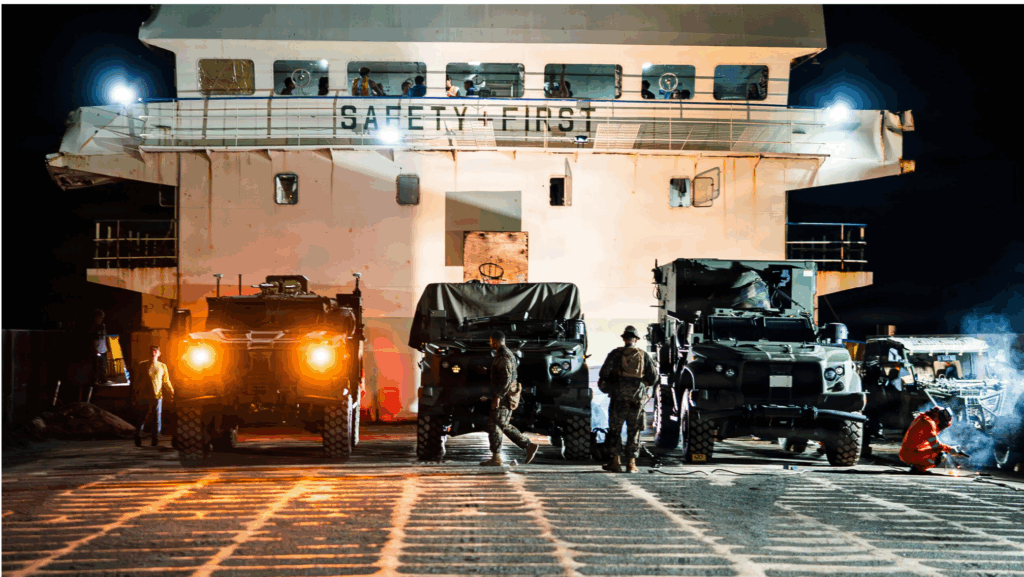
MANILA, PHILIPPINES ― Marine anti-ship missile launchers and air defense rolled off contracted Philippine commercial transport vessels onto an island in the middle of the Luzon Strait near Taiwan during drills earlier this month.
The 3rd Marine Littoral Regiment (MLR) worked with their Philippine counterparts to transport the unit’s maritime strike and air defense systems to Calayan Island during the 10th iteration of the Kaagapay ng mga Mandirigma ng Dagat drills, according to a news release published June 20 by the U.S. Marine Corps. Abbreviated as KAMANDAG, the Marine drills have gradually shifted toward coastal defense activities facing the South China Sea and Luzon Strait.
“The modern littoral environment requires us to rapidly move our forces across challenging maritime terrain,” Maj. Robert Moore, a logistics officer assigned with the regiment, said in the release on the drills.
From the dispersed archipelagos that dot the strategic waters between the Philippines and Taiwan, Marines can hold maritime traffic transiting the Luzon Strait from 100 nautical miles away with the Navy-Marine Expeditionary Ship Interdiction System (NMESIS). The MLR will operate up to 18 of the Naval Strike Missile-armed unmanned vehicles within its anti-ship missile battery, which are further divided into six sections of three launchers each.
“By integrating existing infrastructure, commercial ferries and roll-on, roll-off vessels, the combined force sustained movement across the Batanes Islands during the bilateral maneuvers,” reads the news release.
The MLR fields the Marine Air Defense Integrated Systems, protecting NMESIS from aerial threats. The service deploys two variants of the Joint Tactical Vehicle-mounted systems to provide close-in air defense against attack aircraft and unmanned aerial vehicles. During KAMANDAG, MADIS was deployed alongside NMESIS on commercial Philippine ferries.
Marines with the 3rd MLR have rehearsed scattered deployments across the Babuyan and Batannes Island Groups in recent years during exercises such as KAMANDAG and Balikatan to test their coverage of the archipelagos.
“By integrating existing infrastructure, commercial ferries and roll-on, roll-off vessels, the combined force sustained movement across the Batanes Islands during the bilateral maneuvers,” reads the release.
The MLR plans to use the upcoming McClung-class Landing Ship Mediums (LSM) to move their ship-killing missiles, but the first LSM will not enter service until 2029. Marines have turned to alternative means to maneuver their forces and meet Force Design concepts in the meantime, integrating U.S. Army logistics support vessels and local civilian transports into their operations.
Getting these anti-ship missiles to the remote islands separating Japan, Taiwan and the Philippines is critical in Washington’s plans to counter Beijing in a potential conflict. Marine and Army leadership view ground-based launchers as key to blunting China’s large fleet. Both services are fielding concepts, formations and tactics designed to rapidly insert missiles into these strategic areas.
Through recent deployments to the region, U.S. forces in the Western Pacific now maintain a forward-based maritime strike capability along the first island chain through MLR deployments of NMESIS. Last week, the service announced that the Okinawa-based 12th MLR received the anti-ship missile launchers. The Army’s Mid-Range Capability, which is equipped with Tomahawk cruise missiles and SM-6s for maritime strike operations, has also been flown to the Philippines and Japan. (Aaron-Matthew Lariosa, USNI News)