PH, Japan, Australia, US to hold quad exercises in WPS
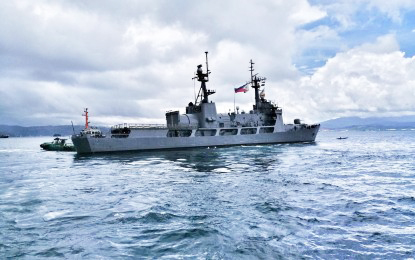
The Philippines, Japan, Australia, and the United States are set to hold a maritime cooperative activity (MCA) within the country’s exclusive economic zone in the West Philippine Sea, the Department of National Defense (DND) announced Saturday.
DND spokesperson Arsenio Andolong said a total of five naval ships will sail from the “south going to the north,” encompassing the maritime boundary of the Armed Forces of the Philippines’ Western and Northern Luzon Commands on Sunday.
Taking part in the MCA are the Philippines’ offshore patrol vessels, BRP Gregorio Del Pilar (PS-15) and BRP Ramon Alcaraz (PS-16); the US Navy’s littoral combat ship, USS Mobile (LCS-26); Australia’s HMAS Warramunga (FFH-152); and Japan’s destroyer JS Akebono (DD-108).
The MCA will include an anti-submarine warfare training, tactical, link and photo exercises.
In a joint statement, the Defense heads of the Philippines, Japan, Australia, and the US said the quadrilateral exercise will demonstrate the four states’ “collective commitment” to strengthen regional and international cooperation in support of a free and open Indo-Pacific.
“Ultimately, the Maritime Cooperative Activity will strengthen the interoperability of our defense/armed forces doctrines, tactics, techniques, and procedures,” the statement read.
“We stand with all nations in safeguarding the international order — based on the rule of law — that is the foundation for a peaceful and stable Indo-Pacific region.”
The four defense chiefs said the MCA will be conducted “in a manner that is consistent with international law as well as domestic laws and rules of respective nations, and with due regard to the safety of navigation and the rights and interests of other states.”
They reaffirmed their position that the 2016 South China Sea Arbitral Tribunal Award is “final and legally binding decision on the parties to the dispute.”
Defense Secretary Gilberto Teodoro Jr., in his statement, said the Philippine series of bilateral and multilateral MCA is a “step in building the country’s capacity” for individual and collective self-defense.
“The Comprehensive Archipelagic Defense Concept that we are implementing includes strengthening and deepening cooperation and interoperability with all nations, big and small, to maintain regional peace and stability as well as good order at sea based on international law, principally UNCLOS (United Nations Convention on the Law of the Sea),” he said.
“This first in a series of activities demonstrates the enduring friendship and partnership among the peace-loving peoples of the Philippines, United States, Australia, and Japan,” he added.
The MCA comes in the wake of continuing tensions in the South China Sea as Beijing asserts its expansive claims, including on several parts of Philippine territory.
Anticipating potential criticisms from Beijing, Andolong said the upcoming MCA would be “an exercise that fully adheres with the international law.”
“It should not (increase tensions with China), kasi (because) this MCA is being conducted within the Philippine EEZ in accordance with international law and established norms in pursuit of our national interest,” he said.
‘Concerns all’
Japanese Defense Minister Minoru Kihara emphasized that cooperation between like-minded countries is vital to ensure regional peace and stability.
He noted that developments in the South China Sea is directly related to the region and “a legitimate concern of the international community.”
“[A]nd thus, Japan opposes any unilateral changes to the status quo by force, such attempts as well as any actions that increase tensions in the South China Sea,” he said.
US Defense chief Lloyd James Austin, for his part, said every country should be free to conduct lawful air and maritime operations.
“These activities with our allies Australia, Japan, and the Philippines underscore our shared commitment to ensuring that all countries are free to fly, sail, and operate wherever international law allows,” Austin said.
“Our operations together support peace and stability at the heart of our shared vision for a free and open region,” he added.
Australia’s Deputy Prime Minister and Defense chief Richard Marles reiterated that Canberra will work with partners to maintain the global rules-based order.
“We recognize that respect for national sovereignty and agreed rules and norms based on international law underpin the stability of our region,” he said.
He added that Australia has consistently emphasized the importance for all states to be able to exercise rights and freedoms, including freedom of navigation, in a manner consistent with international law, particularly the UNCLOS.
“The Maritime Cooperative Activity with the Philippines, Japan and the United States demonstrates our firm commitment to work together to maintain a peaceful, stable and prosperous region,” Marles added. (PNA)