Philippine Navy and U.S. Navy Commence Sama Sama 2024
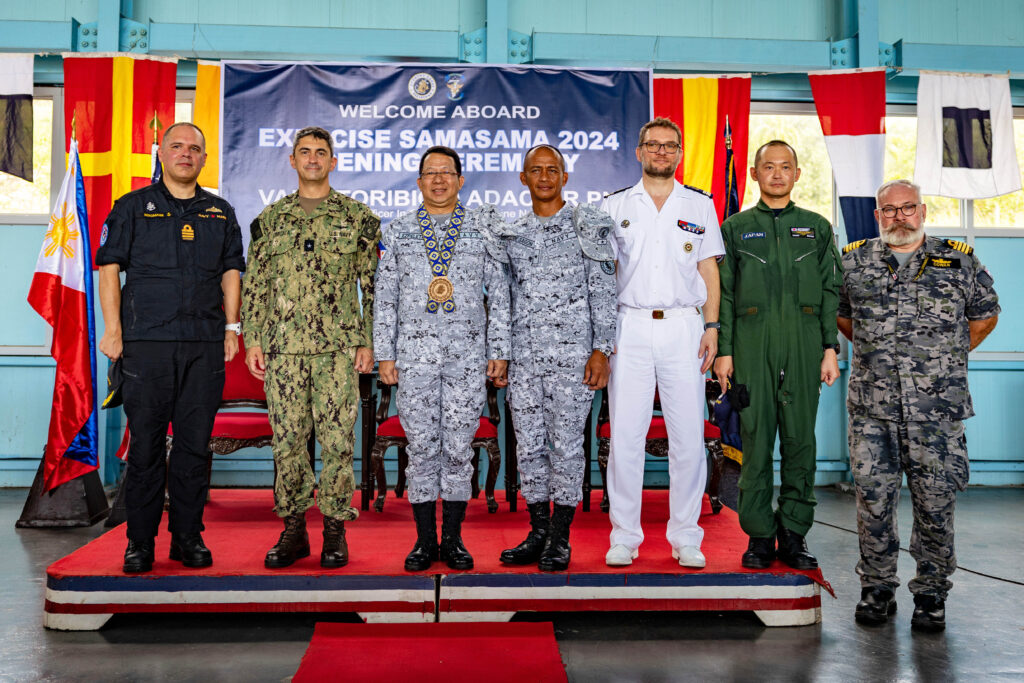
Subic Bay, Philippines – The U.S. Navy, U.S. Marine Corps, Armed Forces of the Philippines, and allied forces commenced the eighth iteration of Exercise Sama Sama in the vicinity of Subic Bay, the Republic of the Philippines, marking the beginning of two weeks of maritime engagements designed to enhance interoperability and strengthen security ties among regional partners, Oct. 7.
Sama Sama 2024, part of the Cooperation Afloat Readiness and Training (CARAT) series, builds on the legacy of previous maritime collaboration, expanding its scope of operations with both shore and sea phases. Participants will engage in specialized training across a wide range of disciplines, including medicine, legal operations, engineering, logistics, and public affairs.
“This exercise has evolved significantly since its inception. What began as a bilateral event between the United States and the Philippines has grown into a multilateral and multiplatform operation, bringing together like-minded partners from across the Indo-Pacific,” said the U.S. Head of Delegation, Rear Adm. Todd Cimicata, Commander Logistics Western Pacific, and Task Force 73. “This development highlights the strength of our alliances and our shared commitment to peace, security, and cooperation in the maritime domain and it’s never been more important.”
Working alongside naval vessels and maritime surveillance aircraft, specialized teams, including diving and explosive ordnance disposal units, will conduct high-intensity drills focusing on anti-submarine warfare, anti-surface warfare, anti-air warfare, and maritime domain awareness.
“Sama Sama”, which means “togetherness” in Tagalog, reflects the spirit of the decades-long partnership between allies in the region. Sama Sama 2024, a Philippine-U.S. bilateral exercise with invited allied and partner participants, continues to evolve in both complexity and scope into a more sophisticated and multinational environment with each iteration.
This year’s exercise includes participants from Australia, Japan, Canada, France, and Japan, representing a collective commitment to stability and security in the Indo-Pacific region.
“Today we witness the deepening of ties between the Philippine Navy and the U.S. Navy along with our partners from Australia, Canada, France, United Kingdom, and Japan” said the Philippine Navy Head of Delegation, Rear Adm. Jose Ma. Ambrosio Ezpeleta, Vice Commander of the Philippine Navy. “This exercise is a powerful investment for our collective movement and an opportunity to address regional challenges together.”
Participating assets from the United States include the Navy’s Arleigh Burke-class guided-missile destroyer USS Howard (DDG 83), and a P-8A Poseidon maritime surveillance aircraft. Personnel from U.S. 7th Fleet; Command Task Forces (CTF) 76, 75 and 72; Command, Destroyer Squadron Seven (DESRON 7); and the Marine Corps’ Marine Rotational Force – Southeast Asia (MRF-SEA), are also taking part in Sama Sama 2024.
From partner nations, we welcome the Philippine Navy’s BRP Jose Rizal (FF 150); BRP Waray (LC-288); BRP Nestor Reinoso (PC 380); a Force Reconnaissance Group, Naval Special Operations Unit 2; and supporting units that include a medical and media team. The Royal Canadian Navy will bring the Halifax-class frigate HMCS Vancouver (FFH 331) and a CH-148 Cyclone helicopter. A Japan Maritime Self-Defense ForceShin Maywa US-2 amphibious aircraft and Kawasaki P-1 maritime patrol aircraft are also participating.
“Through exercises like Sama Sama, we continue to improve our interoperability and our readiness while deepening our understanding of each other’s capabilities. This exercise reflects our enduring partnership—one built on trust, shared values, and mutual defense,” said Cimicata. “Together, we will refine our ability to respond to natural disasters, maritime threats, and humanitarian crises, while ensuring the safety and security of this vital region.
This year marks the 30th iteration of CARAT, a multinational exercise series designed to enhance U.S. and partner navies’ abilities to operate together in response to traditional and non-traditional maritime security challenges in the Indo-Pacific region.
As the U.S. Navy’s forward-deployed DESRON in Southeast Asia, DESRON 7 serves as the primary tactical and operational commander of littoral combat ships rotationally deployed to Singapore. DESRON 7 also functions as the CTF 76 Sea Combat
Commander and builds partnerships through training exercises and military-to-military engagements as the executing agent of Commander, Task Group CARAT.
U.S. 7th Fleet is the Navy’s largest forward-deployed numbered fleet, and routinely interacts and operates with allies and partners in preserving a free and open Indo-Pacific region.